Significant reduction in the Council’s carbon emissions
- Council cuts its carbon emissions by 76% since 2008/09 putting it in top 5% of local authorities for carbon reductions
- Carbon cutting projects have avoided energy costs of an estimated £42m to date
- More major projects in the pipeline to reduce harmful emissions, cut air pollution and improve the environment for Reading residents
The Council has cut its carbon footprint by 76% since 2008/09 showing that it continues to lead by example in Reading.
Government data published earlier this year also revealed that greenhouse gas emissions across the borough as a whole have reduced by 57% since 2005 – the 15th largest reduction out of around 400 UK local authority areas.
The figures are contained in the Council’s Greenhouse Gas report which is published annually and will be presented to members of the Council’s Strategic Environment, Planning and Transport committee on 12 November (https://reading.moderngov.co.uk/ieListDocuments.aspx?CId=139&MId=6269).
Since its baseline year of 2008/09 the Councill has consistently reduced its energy use and associated emissions and is in the top 5% of local authorities for carbon emission reductions. There has been a 9.5% decrease in Council emissions in 2025/26 compared with the previous year.
Compared with the estimated cost of taking no action, these reductions have delivered avoided energy costs of around £41.9m to date, including £6.5m in 2025/26 alone.
There are several decarbonisation projects currently being implemented by the Council which include installation of heat pumps to reduce the use of gas.
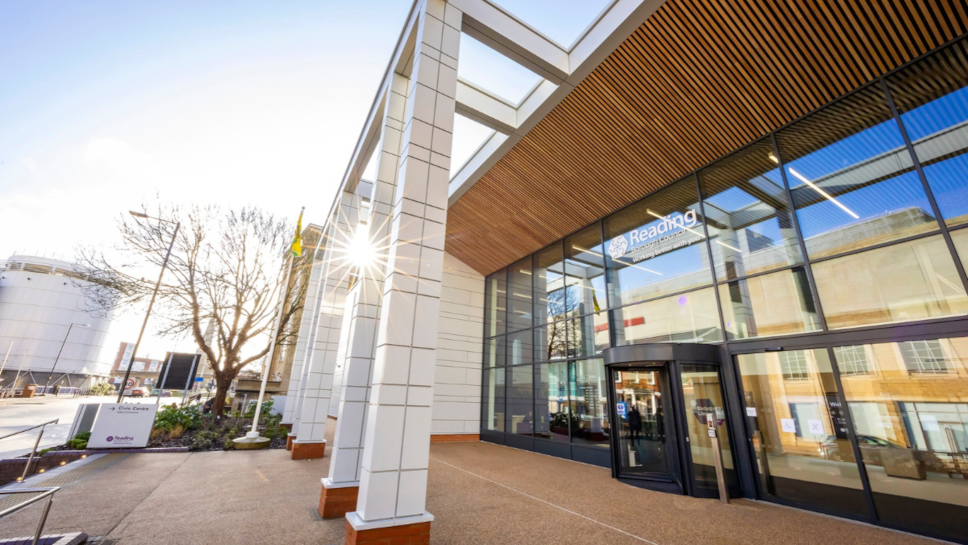
The Civic Centre now has heat pumps and chillers providing heating and cooling, as well as solar panels generating renewable energy. The new Central Library moved out of its old building and is now located in the Civic, which has also resulted in significant carbon savings.
The Hexagon theatre is now disconnected from the gas supply and is heated and cooled by water sourced heat pumps, as will the new Studio Theatre when it opens next spring.
Roof improvement works at the Town Hall are planned and will include better insulation to improve energy efficiency at the Grade II listed building.
The Council has installed more than 10,000 solar panels on its corporate buildings, housing and schools so far and is about to start a major new solar installation at the Reading Buses depot in partnership with Reading Community Energy Society. The Council has also worked with Reading Buses to secure funding for a total of 49 electric buses for the town.
Electric vehicle chargers are also being installed in residential streets across Reading to provide convenient access to public charge points for households.
An application has been made to the Government to support the development of a heat network for Reading. The proposal is for a heat network which would be powered using low carbon renewable energy sources such as aquifers and rivers.
The network could extend from Reading School in the east to the Minster Quarter to the west and service the Royal Berkshire Hospital and University of Reading London Road campus on route.
The Council has shown strong leadership by reducing its emissions faster than the wider borough but has not been able to meet the ambitious target of an 85% reduction by 2025/26.
A second carbon plan is currently being prepared which will set out a strategy for reducing emissions further as soon as possible.
Cllr John Ennis, Lead Councillor for Climate Strategy and Transport, said:
“The Council has demonstrated a strong commitment towards cutting its carbon emissions over many years and has achieved a reduction of 76% since 2008/09.
“Major projects such as the decarbonisation of our leisure centres, arts and leisure venues and the Civic Offices has helped us to avoid around £42m in energy costs, therefore saving Council Tax payers money.
“The Council is continuing to drive forward an innovative and bold programme with the installation of thousands of solar panels and plans for a major new heat network project.
“Reading declared a climate emergency in 2019 and set ambitious targets for carbon reductions beyond those adopted nationally as well as settings its own corporate carbon plan aims.
“Borough emissions and the Council’s carbon emissions have been cut significantly which consistently puts us among the top performers in the country but, of course, not everything is within the Council’s or borough’s control.
“It is also worth noting that the Council’s carbon emissions only account for 1.2% of the borough’s total emissions.
“There is still much work to done to reach the Council’s and borough’s ambitious carbon reduction targets and we will continue to work with our partners and residents to accelerate the transition away from fossil fuels, achieve net zero and improve the environment for everyone in Reading.”