New Homelessness and Rough Sleeping Strategy drives changes to accommodation and support services
- Council to put greater emphasis to be on preventing homelessness and longer-term housing and support solutions
- Strategy will see the temporary Caversham Road pods site decommissioned by September 2027
- Shift away from large-scale, intensely populated supported housing models mirrors national best practice
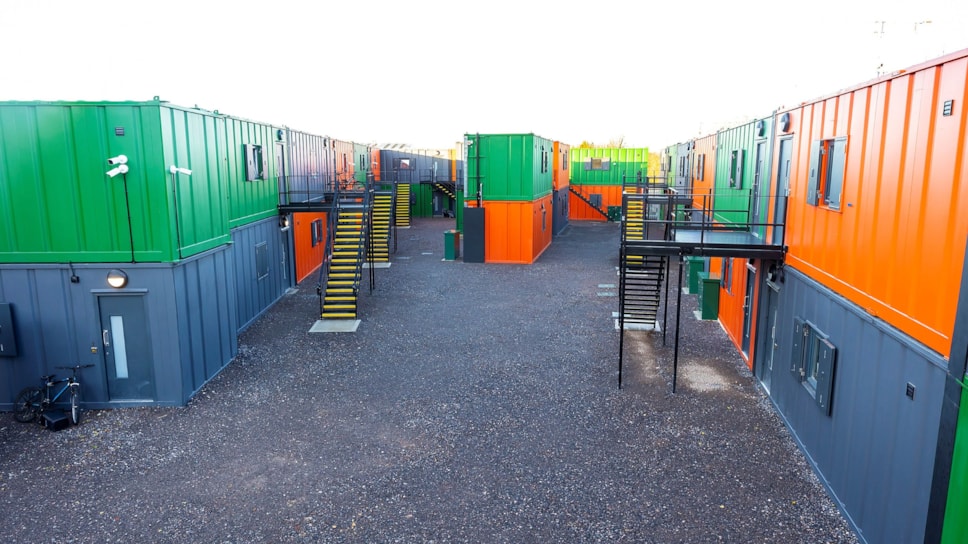
People currently living at the Caversham Road Pods will be supported to move into alternative accommodation, as the Council moves to decommission the service over the next year.
The approach, agreed at a meeting of the Council’s Policy Committee last night, reflects the priorities set out in Reading’s new Preventing Homelessness and Rough Sleeping Strategy 2026-2031, adopted earlier this year. The strategy places a greater emphasis on preventing homelessness and rough sleeping, alongside providing longer-term housing and support solutions for those who need them.
The Caversham Road Pods were initially created to solve the short-term emergency of getting people off the streets during the pandemic. Since then, they have provided safe accommodation and support to people who would otherwise have been at risk of rough sleeping. Commissioned by the Council, Launchpad has successfully delivered the service over several years, supporting residents through periods of crisis and helping many people move towards more stable accommodation and independent living.
While the Pods provided stability and a supportive environment following Covid, the Council believes that more dispersed housing alongside personalised support can offer better long-term outcomes for people with complex needs. This approach can improve opportunities to sustain tenancies, engage with services and build independence, while reducing some of the challenges that can arise when people with a wide range of needs are supported in a larger, single-site setting.
It was originally anticipated that the project might close in September 2026 when temporary planning permission expired. However, the Council has extended that timeframe until September 2027 to support a careful, planned transition for residents. Over the next 13-months, a phased approach will see residents individually assessed, with support offered to help them access suitable accommodation and services where this is appropriate. The Council will continue to work closely with residents throughout the process and ensure individual support needs are considered.
Since 2018 Reading Council’s ‘Housing First’ programme has provided secure, long-term housing opportunities for people with a history of rough sleeping, predominantly through the Council’s own housing stock. The Council intends to redirect resources currently used for the Pods to strengthen its homelessness prevention and supported housing offer, helping more people access sustainable accommodation and support.
The service is expected to be fully decommissioned by September 2027.
Councillor Matt Yeo, Lead for Housing at Reading Borough Council, said:
“The needs of the individual are always at the forefront of our mind when making decisions about our homelessness and rough sleeping support services. Experience and evidence suggest that more dispersed accommodation models, combined with the appropriate personalised support, provide a better opportunity for some people with complex needs to engage with services, recover and work towards long-term stability to break the cycle of rough sleeping.
“While the Pods served an important purpose at the time of the pandemic, and since then with some great work by Launchpad they have successfully helped many people through periods of crisis, they were only ever intended to be temporary.
“Current national best practice* favours a shift away from large-scale, intensely populated supported housing models, and towards dispersed approaches where possible which is reflected in our recently adopted Homelessness and Rough Sleeping Strategy”.
Reading Borough Council will continue to work closely with its commissioned homelessness prevention partners, including Launchpad Reading, who currently manage the Pods site, as well as St Mungo’s, The Salvation Army and YMCA Reading, to help ensure appropriate support and accommodation options remain available for people at risk of homelessness and rough sleeping.”
Notes to editors
*Current national best practice and the National Plan to End Homelessness, published in December 2025, prioritises a shift away from large-scale, intensely populated supported housing models toward dispersed approaches, such as Housing First.